
2026 EDITION · Available
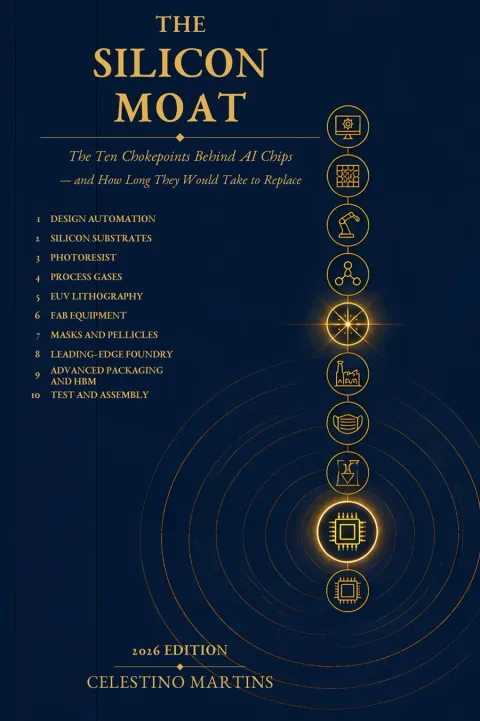
THE SILICON MOAT
The Ten Chokepoints Behind AI Chips — and How Long They Would Take to Replace
- Author
- Celestino Martins
- Publisher
- Edenareia Editions
- Format
- 6 × 9 inches · 395 pages
- Language
- English
- Status
- Available
- ASIN
- B0HGZHXCQG
The book
AI chips do not depend on a single company.
They depend on a chain of industrial capabilities whose failure can stop the entire path from design to deployed compute.
THE SILICON MOAT asks a harder question than who leads the semiconductor industry: if one critical link became unavailable, how long would it take to build a credible alternative?
Using an explicit 2026 evidence cut-off, the book examines ten chokepoints across design automation, silicon substrates, photoresists, process gases, EUV lithography, fab equipment, masks and pellicles, leading-edge foundry, advanced packaging and HBM, and test and assembly. Each assessment separates market share from substitutability and focuses on qualification time, installed capacity, tacit process knowledge, ecosystem depth, and the evidence that would force a revision.
- 01Design automation
- 02Silicon substrates
- 03Photoresist
- 04Process gases
- 05EUV lithography
- 06Fab equipment
- 07Masks and pellicles
- 08Leading-edge foundry
- 09Advanced packaging and HBM
- 10Test and assembly
Back cover
AI chips depend on ten industrial chokepoints.
Some can be replaced in months. Others would take a decade — or have no demonstrated substitute.
An advanced AI accelerator passes through ten industrial links before it reaches a server. Those links include design automation, silicon substrates, photoresist, process gases, EUV lithography, fab equipment, masks and pellicles, leading-edge foundry, advanced packaging and HBM, test and assembly. The layers are serial. Strength in one does not compensate for the absence of another.
Most supply-chain maps answer a descriptive question — who makes what. This book answers a harder one: if a link became unavailable under a defined failure mode, how long would it take to build a credible route around it?
That question becomes the Substitutability Index, an ordinal S1-to-S5 scale measuring industrial route-around time, applied to all ten links and dated to a stated evidence cut-off. Two links score S5 — no demonstrated route around within a decade. Three score S2. Every score carries the evidence that would force a revision.
Inside:
- The ten dated assessments, from under one year to more than a decade
- Export controls, allied alignment, and where multilateral control stops working
- Substitution strategies, node labels versus manufacturing capability, and tacit process knowledge
- Rebuilding programmes — and the power, water and site constraints beneath every fab
- Valuing industrial duration: separating route-around time from company excess returns
- The hidden moats: multi-beam mask writers, probe cards, RF power delivery, vacuum control, optical packaging
- A dependency matrix, a glossary, a chronology from 1958, and a monitoring framework to 2030
Written for investors, analysts and policy readers who already know what TSMC and ASML are — and need to know what happens if one of them stops.
This book does not provide investment advice. It contains no price targets and no recommendations to buy, hold or sell any security.
Availability
Amazon.com
Kindle
Also available on Kindle Unlimited
Paperback
Also listed on Amazon.fr.
No price is displayed.